
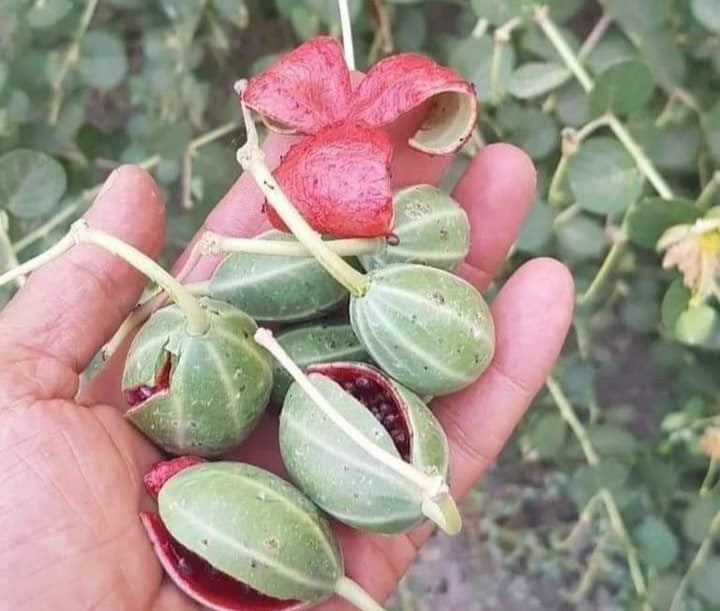
Common name: Shafallah
Scientific name: Capparis spinosa
Also called: Caper - Kabar - Asaf
Description of the caper shrub:
• A wild, thorny, flowering shrub belonging to the Capparis family. It is characterised by its many branches and is considered a creeping and climbing plant for walls and fences. Its leaves are thick and round to oval in shape. Its length reaches more than two metres and its width is approximately three metres.
Uses and benefits:
- Shaflah is a honey plant that enjoys rare flowering weather, where nectar is scarce for bees. - Shaflah honey also boasts numerous health benefits.
Flower:
The shamrock flowers are large, white to pink flowers that bloom for five months of the year, starting in mid-May.
Fruit and seeds:
Its fruits are dark green, pear-shaped, 5 cm long, and have red flesh containing seeds.
Hometown:
• The Mediterranean Basin is cultivated in desert and semi-arid lands due to its ability to withstand harsh weather conditions and its preference for dry climates. Shafallah is cultivated in Saudi Arabia and the Gulf states as a suitable plant for developing vegetation cover.
Weather and soil conditions suitable for agriculture:
Shafallah requires an arid or semi-arid climate and is capable of withstanding the harshest climatic conditions. It can withstand frost and cold temperatures as low as -4°C and temperatures exceeding 40°C. The climate of Saudi Arabia and the Gulf states is ideal for growing shafallah.
It is best to grow saffron in calcareous or sandy soil. It also grows in rocky, calcareous, gypsum, and sandy soils, as it adapts well to poor soils.
Planting method:
Shaflah can be easily grown using seeds and also by planting cuttings.