
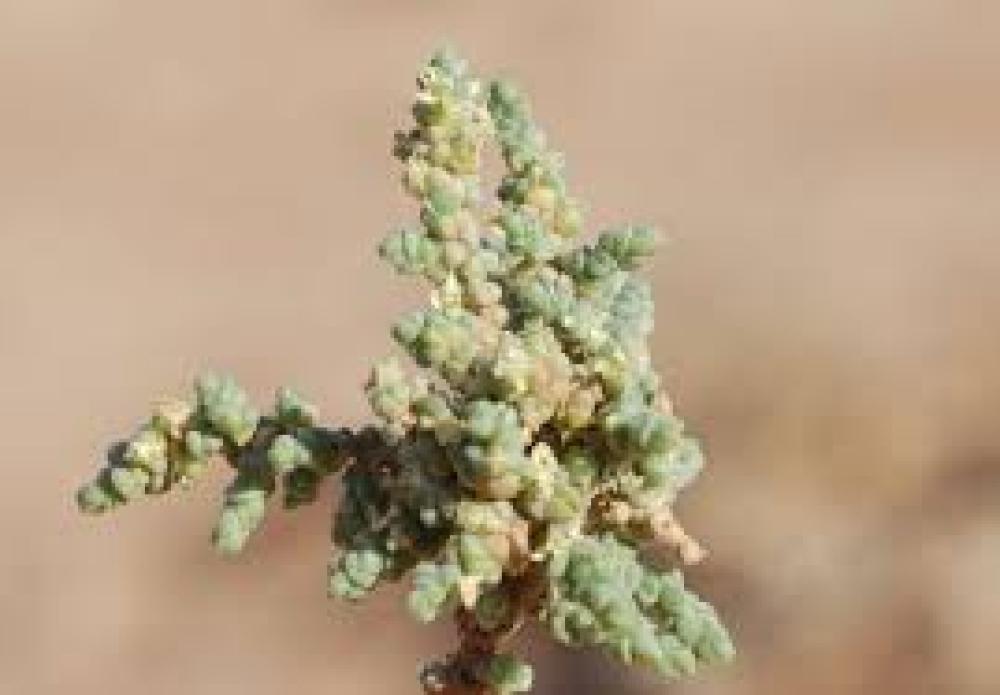
Horsetail seeds ( Salsola tetrandra Forssk. )
Common name
- horsetail
Scientific name
- Salsola tetrandra Forssk.
plant family
- Amaranthaceae – formerly in the Chenopodiaceae family
Botanical description
Horsetail is a perennial herbaceous plant that typically grows in arid and semi-arid environments.
- Stems : branched and dense.
- Leaves : Small, alternate, often needle-like or fleshy to reduce water loss.
- Height : The plant may reach approximately 50–100 cm in height depending on environmental conditions.
- Flowers : Small and inconspicuous, greenish-white, appearing singly or in clusters at the tips of branches.
Habitat and distribution
- Its native habitat is the Arabian Peninsula .
- It is also widespread in areas of the Middle East and North Africa, especially in desert and semi-desert lands.
- It grows abundantly in valleys, sand dunes, and salty areas .
Environment and Adaptation
- Tolerates high temperatures and prolonged drought.
- Able to grow in sandy and saline soils.
- It plays an important role in stabilizing soil and preventing erosion.
Reproduction
- Horsetail is mostly propagated by seed .
- It is planted at the beginning of the rainy season to ensure successful germination.
Benefits and uses
- 🌿 Grazing : It is considered one of the pasture plants that camels and sheep feed on in desert environments.
- 🌍 Environment : It contributes to soil stabilization and combating desertification.
- 💊 Traditional medicinal uses : Some species of Salsola have been used in folk medicine as treatments for skin and digestive diseases.
Homeland
- Arabian Peninsula.
- Some areas of the Arab world have a dry climate.